All case studies
PC hardware commerce prototypePersonal projectLive interface prototype

PartStack

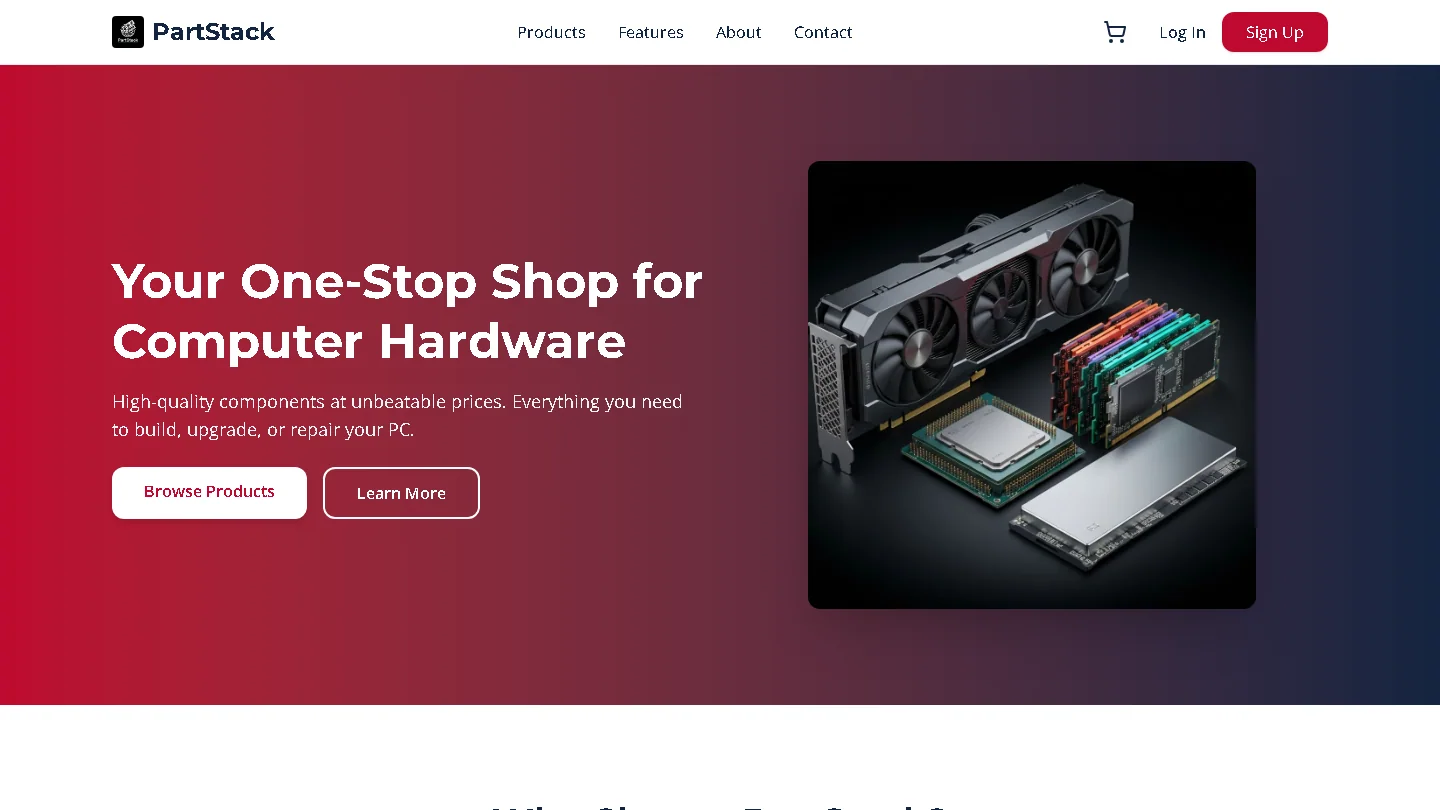
An AI-assisted commerce prototype spanning product discovery, responsive multi-route navigation, cart entry, trust messaging, and customer-contact flows.

Role
Frontend Developer · AI-assisted prototyping
Ownership
Personal project
Source
Personal AI-assisted prototype; public deployment available
Stack
Next.js · React · Tailwind CSS · Vercel
PartStack computer hardware commerce prototype landing page
01

Context

The system and the operational problem.

A hardware storefront needs to help shoppers understand the offer, discover relevant products, enter a cart journey, and find support without turning the first release into an oversized commerce build.

02

Responsibility

What I owned and what I contributed.

Created and deployed the public Next.js prototype to explore storefront information architecture, reusable responsive sections, multi-route navigation, catalog entry points, and cart and contact interfaces. The public evidence supports interface and prototype scope; it does not establish production inventory, authentication, checkout, payment, or fulfillment services.

03

Constraints

The engineering challenge.

  1. 01

    Giving a broad computer-hardware catalog a focused first-screen value proposition

  2. 02

    Keeping product, feature, company, cart, and contact routes coherent across devices

  3. 03

    Using AI-assisted generation while retaining engineering judgment over scope, structure, and review

04

Approach

How the problem was framed.

  1. 01

    Start with the shopper journey: understand the offer, browse products, evaluate trust, and reach cart or support.

  2. 02

    Use reusable navigation and content patterns so the prototype can expand without fragmenting the experience.

  3. 03

    Treat AI as an acceleration layer, then inspect the generated structure, responsive behavior, wording, and claim boundaries.

05

Implementation

The layers that made the workflow work.

01

Application

Next.js and React implementation across the public home, products, features, about, cart, and contact routes.
02

Interface system

Responsive layouts, reusable navigation, product-discovery entry points, calls to action, and customer-support messaging.

03

AI-assisted workflow

Rapid interface prototyping supported by AI generation, followed by human review of hierarchy, route coverage, responsive behavior, and evidence boundaries.

04

Deployment

Public Vercel deployment for direct inspection of the current prototype.

06

Operational value

Concrete outcomes, without invented metrics.

  • Establishes a multi-route storefront concept that can be evaluated before backend investment.
  • Connects discovery, cart entry, trust messaging, and support into one responsive interface direction.
  • Demonstrates an accountable AI-assisted workflow without presenting prototype UI as completed commerce infrastructure.

Engineering reflection

AI can compress the time needed to explore a storefront direction, but speed does not replace product judgment. The useful result is a reviewable prototype with explicit boundaries and a clear path to production engineering.
Next.jsReactTailwind CSSVercelAI-assisted prototyping

Next case study

YAHSHUA One

Payroll & HRIS platform

Continue reading

Does this map to the work you're hiring for?

Start a conversation